
Posts by Jennifer Eubanks
List of the Best DCAA Approved and Compliant Accounting Software Systems

Summary of Keypoints DCAA-compliant accounting software is essential for government contractors: These systems support audit readiness, FAR and CAS compliance, accurate cost allocation, transparent reporting, scalability, and reduced risk of penalties or lost contracts. Core features define DCAA compliance: Required capabilities include a compliant general ledger, detailed cost accounting for direct and indirect costs, approved…
Read MoreA Complete Government Contract Compliance Checklist: A Guideline for Success

Summary of Keypoints Compliance is a competitive advantage in government contracting: Adhering to FAR, CAS, labor laws, cybersecurity standards, and contract-specific requirements helps contractors win contracts, avoid penalties, ensure smooth operations, and build long-term trust with government agencies. Core compliance areas span finance, labor, ethics, and cybersecurity: Contractors must maintain a DCAA-compliant accounting system, properly…
Read MoreWhat is an Adequate Accounting System for Contract Proposals?

Summary of Keypoints An adequate accounting system is foundational to government contract success: It supports compliance, audit readiness, accurate cost proposals, financial transparency, and strengthens competitiveness during the bidding process. Compliance and cost accuracy are primary objectives: The system must meet FAR and DCAA standards, precisely track and allocate direct and indirect costs, and support…
Read MoreWhat is a Forward Pricing Rate Proposal and Why is it Important?

Summary of Keypoints A Forward Pricing Rate Proposal (FPRP) is a forecast of future indirect rates: It projects overhead, G&A, fringe, and labor rates for a defined future period and is submitted to agencies like DCMA to support government contract negotiations. FPRPs are central to fair contract pricing and negotiations: They establish cost realism and…
Read MoreCompliance as a Growth Driver: Accounting for Commercial and Government Funded Contracts

Summary of Keypoints R&D-focused companies often rely on both commercial and federal funding, which creates complex accounting and compliance obligations under GAAP, IRS rules, and federal regulations tied to how the funding is awarded. Federal funding compliance varies by mechanism: Grants and cooperative agreements are governed by 2 CFR Part 200, with strict requirements around…
Read MoreContract Briefs & Provisional Billing Rates: Paving the Way for Financial Success in Government Contracting

Summary of Keypoints Contract Briefs and Provisional Billing Rates are foundational tools in government contracting, supporting both compliance and financial performance by aligning contract requirements with effective cost management and cash flow practices. Contract Briefs act as a strategic contract roadmap, summarizing key terms, compliance obligations, risks, performance benchmarks, and resource needs to improve clarity,…
Read MoreThe Top 10 Benefits of an Outsourced CFO

Summary of Keypoints Outsourced CFOs provide high-level financial leadership without full-time cost, giving businesses access to senior expertise on a flexible, as-needed basis while avoiding salary, benefits, and overhead associated with in-house CFOs. They deliver objective, strategic financial insight, offering unbiased analysis, fresh perspectives, and data-driven guidance to support better decision-making, risk management, and long-term…
Read MoreJennifer Eubank’s Article Wins 2022 Accountant Advocate MVP Awards.
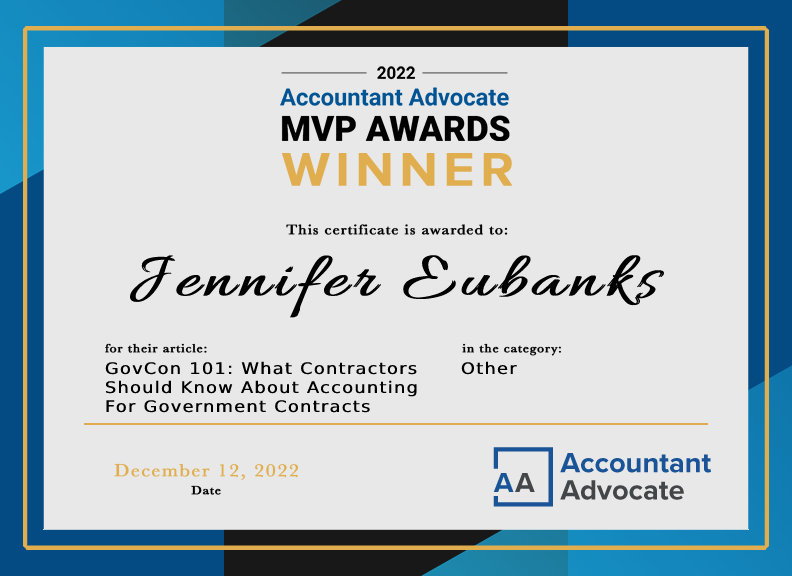
Jennifer Eubank’s article GovCon 101: What Contractors Should Know About Accounting For Government Contracts,” has won 1st place in the 2022 Accountant Advocate MVP Awards Other category! To learn more, visit here.
Read MoreGovCon 101: What Contractors Need To Know About Indirect Rates

Summary of Keypoints The article is part of a GovCon 101 series focused on selling to the federal government, building on earlier discussions of FAR, CAS, contract types, and the distinction between direct and indirect costs. This installment focuses specifically on indirect rates and rate structures, explaining how indirect costs—those not easily traceable to a…
Read MoreJennifer Eubanks Contribution to Forbes Expert Panel: 15 Expert Tips To Help Small-Business Owners Better Manage Financial Risk

Summary of Keypoints Jennifer Eubanks contributed expert insight to a Forbes Finance Council article titled “15 Expert Tips To Help Small-Business Owners Better Manage Financial Risk,” alongside other finance leaders. The article focuses on financial risk management for small businesses, addressing challenges such as tax obligations, overhead costs, economic uncertainty, natural disasters, inflation, and limited…
Read More