
Posts Tagged ‘accounting’
Tax Implications of Government Contract Types: Choosing the Right Fit for Your Business

Summary of Keypoints Government contract type directly affects tax timing, reporting, and audit exposure, influencing when income is recognized, how expenses are deducted, and how closely your records are scrutinized by agencies like the IRS and DCAA. Fixed-price contracts offer revenue predictability but can accelerate taxable income, requiring careful use of percentage-of-completion revenue recognition and…
Read MoreCompliance as a Growth Driver: Accounting for Commercial and Government Funded Contracts

Summary of Keypoints R&D-focused companies often rely on both commercial and federal funding, which creates complex accounting and compliance obligations under GAAP, IRS rules, and federal regulations tied to how the funding is awarded. Federal funding compliance varies by mechanism: Grants and cooperative agreements are governed by 2 CFR Part 200, with strict requirements around…
Read MoreAccrual vs Cash Accounting for Small Businesses: Which is Right for You?

Summary of Keypoints Accrual and cash accounting differ in when income and expenses are recorded, with accrual accounting recognizing transactions when they are earned or incurred, and cash accounting recognizing them only when money changes hands. Accrual accounting provides a clearer picture of long-term performance, matching revenues and expenses to the correct periods and tracking…
Read MoreUnderstanding Allowable Costs Speeds Reimbursement: 6 Best Practices for Avoiding Unallowable Costs

Summary of Keypoints Allowable costs must meet strict federal standards, requiring that expenses be reasonable, allocable, necessary to the project, consistently treated, adequately documented, and compliant with FAR, contract terms, and applicable accounting standards such as GAAP or CAS. Unallowable costs are common but must be excluded from government billings, as submitting them for reimbursement…
Read MoreJennifer Eubank’s Article Wins 2022 Accountant Advocate MVP Awards.
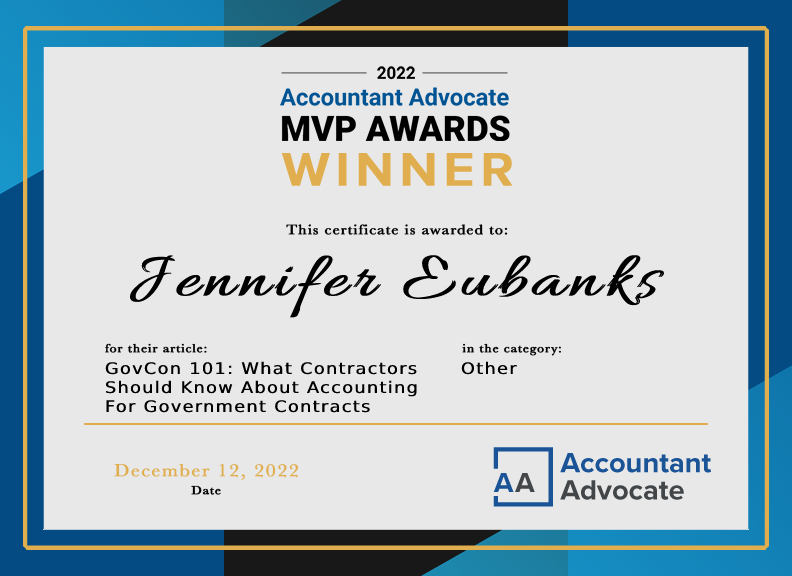
Jennifer Eubank’s article GovCon 101: What Contractors Should Know About Accounting For Government Contracts,” has won 1st place in the 2022 Accountant Advocate MVP Awards Other category! To learn more, visit here.
Read MoreGovCon 101: What Contractors Need To Know About Indirect Rates

Summary of Keypoints The article is part of a GovCon 101 series focused on selling to the federal government, building on earlier discussions of FAR, CAS, contract types, and the distinction between direct and indirect costs. This installment focuses specifically on indirect rates and rate structures, explaining how indirect costs—those not easily traceable to a…
Read MoreGovCon 101: What Contractors Should Know About Accounting For Government Contracts

Summary of Keypoints The article introduces foundational accounting concepts for government contractors, building on prior discussions of Federal Acquisition Regulations (FAR) and government contract types. It is designed for contractors new to government accounting requirements, explaining how accounting practices differ when the federal government is the customer. The piece highlights why proper accounting is critical…
Read MoreJennifer Eubanks Forbes Feature Article: What Prospective Contractors Need To Know When Preparing To Bid For A US Federal Government Contract

Summary of Keypoints The Forbes feature explains why the U.S. federal government is an attractive customer, citing its large, reliable spending and counter-cycclical nature during economic downturns. The article emphasizes that government contracting differs significantly from commercial work, requiring contractors to understand the regulatory framework governing federal procurement and contract performance. Key preparation areas include…
Read MoreWhat is an Adequate Accounting System? 10 Questions to Determine if Your Accounting System is Adequate for Government Contracts

In many cases, having an “adequate accounting system” is an integral part of successfully winning and performing on Federal contracts. Many companies find it challenging to determine when accounting system requirements are triggered and how to navigate obtaining a determination of adequacy. Our clients and prospects unanimously have the same questions. Since these questions are…
Read MoreJennifer Eubanks Contribution to Forbes Expert Panel: 14 Important Financial Steps When Bringing On Remote Staff From Different Locations

Summary of Keypoints Jennifer Eubanks contributed expert insight to a Forbes Finance Council article titled “14 Important Financial Steps When Bringing On Remote Staff From Different Locations.” The article addresses financial and compliance challenges of remote work, including navigating multi-state and international labor laws, tax regulations, and payroll requirements. Guidance focuses on updating financial policies…
Read More