
Posts Tagged ‘government contracting’
Contract Briefs & Provisional Billing Rates: Paving the Way for Financial Success in Government Contracting

Summary of Keypoints Contract Briefs and Provisional Billing Rates are foundational tools in government contracting, supporting both compliance and financial performance by aligning contract requirements with effective cost management and cash flow practices. Contract Briefs act as a strategic contract roadmap, summarizing key terms, compliance obligations, risks, performance benchmarks, and resource needs to improve clarity,…
Read MoreThe Cornerstone of Winning Bids: Understanding Proposal Adequacy for Government Contractors

Summary of Keypoints Proposal adequacy is the baseline requirement for winning government contracts, ensuring a proposal fully aligns with all financial, technical, and compliance requirements outlined in the Request for Proposal (RFP). Adequate proposals reduce risk and protect reputation, as incomplete or inconsistent submissions can be rejected outright or trigger increased scrutiny from agencies such…
Read MoreWhat is Uncompensated Overtime? Understanding DCAA Timekeeping Requirements

Summary of Keypoints Uncompensated overtime refers to hours worked beyond 8 hours per day or 40 hours per week by salaried, FLSA-exempt employees, and must be recorded even though no additional pay is issued. DCAA requires total time accounting, meaning contractors must record and allocate all hours worked (paid and unpaid) to ensure equitable labor…
Read MoreUnderstanding Incurred Cost Proposals: Avoiding the Top 5 Audit Issues

Summary of Keypoints Incurred Cost Proposals (ICPs) are required annually for contractors with cost-type or T&M contracts, and reconcile provisionally billed indirect costs with actual incurred costs to establish final indirect rates and calculate over- or under-billings. The ICP functions like a tax return for government contracts, finalizing indirect rates after the fiscal year closes…
Read MoreUnderstanding Allowable Costs Speeds Reimbursement: 6 Best Practices for Avoiding Unallowable Costs

Summary of Keypoints Allowable costs must meet strict federal standards, requiring that expenses be reasonable, allocable, necessary to the project, consistently treated, adequately documented, and compliant with FAR, contract terms, and applicable accounting standards such as GAAP or CAS. Unallowable costs are common but must be excluded from government billings, as submitting them for reimbursement…
Read MoreJennifer Eubank’s Article Wins 2022 Accountant Advocate MVP Awards.
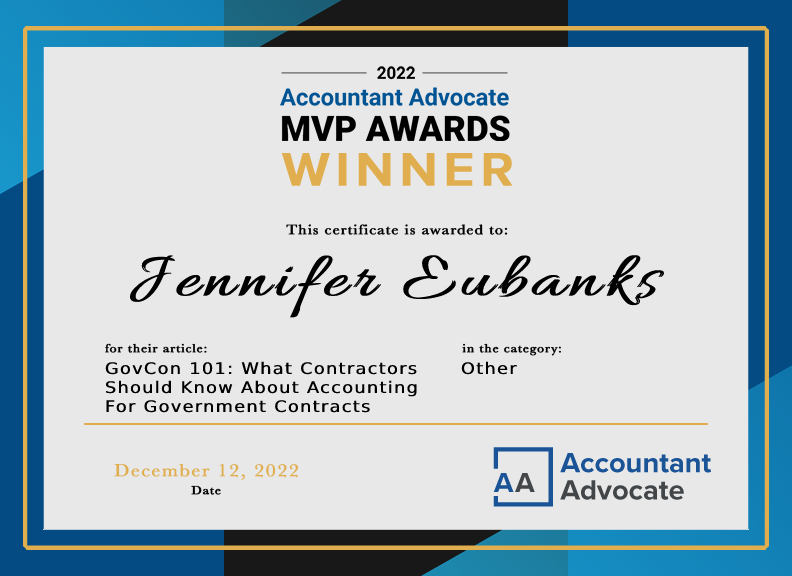
Jennifer Eubank’s article GovCon 101: What Contractors Should Know About Accounting For Government Contracts,” has won 1st place in the 2022 Accountant Advocate MVP Awards Other category! To learn more, visit here.
Read MoreGovCon 101: What Contractors Should Know About Accounting For Government Contracts

Summary of Keypoints The article introduces foundational accounting concepts for government contractors, building on prior discussions of Federal Acquisition Regulations (FAR) and government contract types. It is designed for contractors new to government accounting requirements, explaining how accounting practices differ when the federal government is the customer. The piece highlights why proper accounting is critical…
Read MoreThe Complete Guide to DCAA Pre Award Audits: An 8 Point Readiness Checklist

Sumary of Keypoints A DCAA pre-award audit is required before awarding cost-reimbursable defense contracts, assessing whether a contractor’s accounting system can properly track, allocate, and report contract costs before funding is released. The purpose of the pre-award audit is to determine contractor qualification, focusing on accounting policies, procedures, and internal controls rather than conducting a…
Read MoreJennifer Eubanks Forbes Feature Article: What Prospective Contractors Need To Know When Preparing To Bid For A US Federal Government Contract

Summary of Keypoints The Forbes feature explains why the U.S. federal government is an attractive customer, citing its large, reliable spending and counter-cycclical nature during economic downturns. The article emphasizes that government contracting differs significantly from commercial work, requiring contractors to understand the regulatory framework governing federal procurement and contract performance. Key preparation areas include…
Read More